
Product footprint
ERP modules your teams already recognise
The marketing site mirrors the Teacher Portal structure: discrete domains for admission, registers, exams, fees, people, infrastructure, and administration — so rollout and training stay grounded in real workflows.
Admission
New admissions, waiting lists, downloadable forms, bulk intake, and LC demand workflows — designed for predictable enrolment cycles and auditable decisions.
Registers & reports
General, Nirgam, leaving certificate, Goshvara, daily and consolidated attendance registers, and class-wise listings aligned to statutory and academic reporting needs.
Examination
Exam dashboard, scheduling, registers, result dates, working-day configuration, semester cycles, repeater analytics, Sanklit registers, and formative assessment paths where enabled.
Fees management
Fees dashboard, fee types, and student fee registers so finance teams reconcile collections against academic structure without spreadsheet drift.
Faculty & extended ops
Teacher lifecycle and registers; optional hostel registers by category; bus operations including routes, attendance, fleet finance, and maintenance when transport is enabled.
Official · setup · governance
Vendor and procurement surfaces, chart-of-account ledgers where activated, plus foundational setup for subjects and institutional master data — administered with role separation.
Why GoDigiSchool
ERP-grade control for schools that cannot afford ambiguity
Leadership gets a single operating layer: enrolment intake, compliance-oriented registers, examination governance, fee integrity, and optional hostel and transport operations — the same scope surfaced in the Teacher Portal sidebar, adapted to your board and UDISE context.
Security and performance are treated as platform responsibilities — not add-ons — so peak-day exams, fee deadlines, and admission peaks stay within predictable service levels.
Read positioning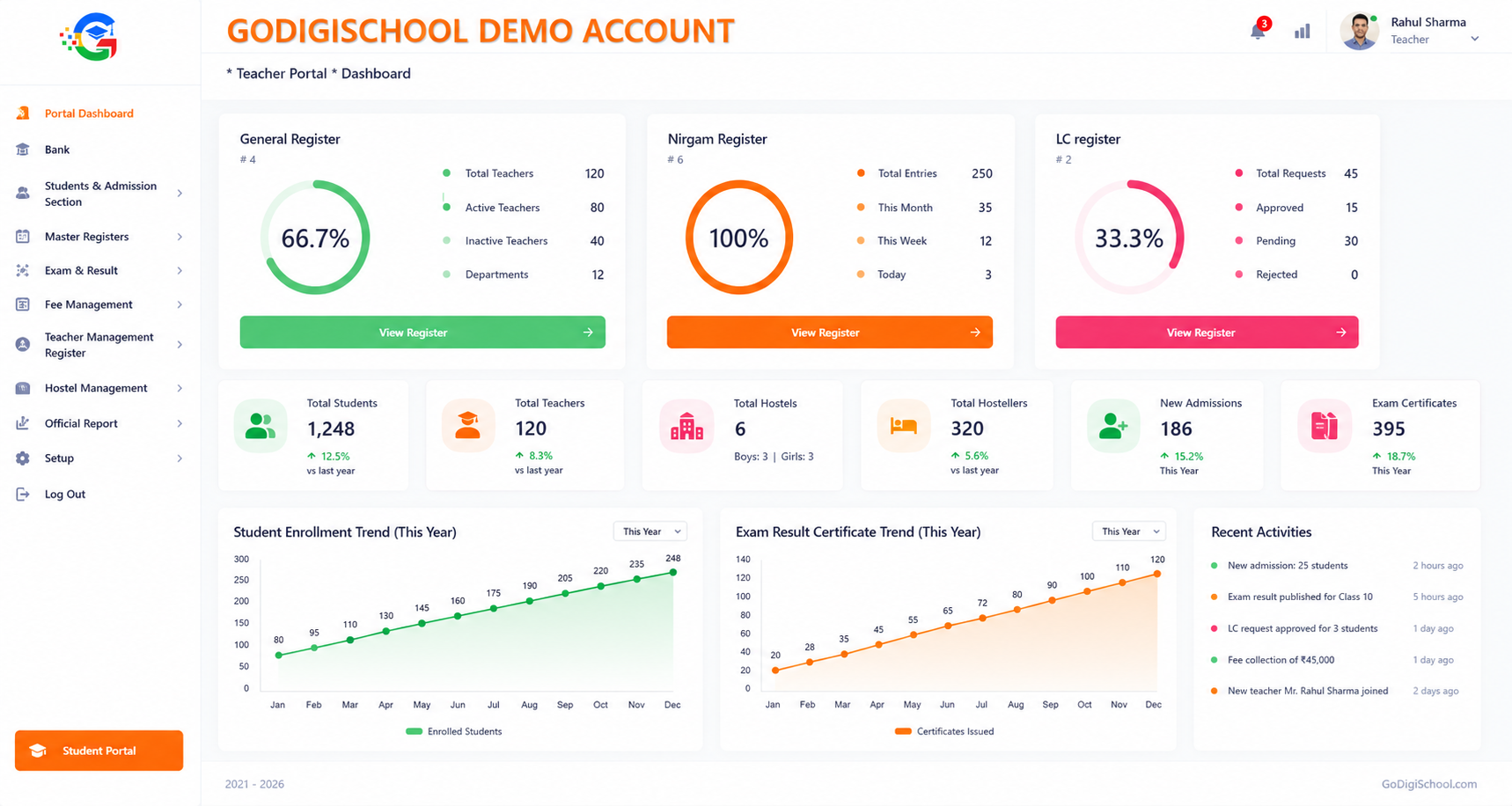
Execution layer
How teams work inside the ERP
Daily operations map to the same menu clusters teachers and administrators see: capture once, reconcile across registers, exams, and finance — without redundant data entry.
Registers & attendance
Mark and reconcile attendance; surface summaries for exam cycles and leadership reviews.
Examination pipeline
Plan papers, capture outcomes, publish result timelines, and maintain statutory exam registers.
Fees & student ledger
Align billing structures with enrolment and produce finance-ready fee registers.
Teacher & student channels
Structured communication tied to classes, assessments, and fee events — auditable and scoped by role.